

Your brain was hardwired to copy
Why every master you admire was a copycat first

Two people start learning the same skill on the same day.
Same natural ability. Same hours practiced. Same teacher.
Six months later, one is fluent. The other is still fumbling through the basics.
What made the difference?
Talent? Effort? Some mysterious gift one person has and the other does not?
(Well, sort of. But not in the way you think.)
The one who got good was copying. Word for word, move for move, stroke for stroke. The one who struggled was trying to be original from day one.
You have probably been told that copying is cheating. That you should find your own voice.
That advice is backwards.
If you have been trying to learn something new and you feel stuck, this is probably why.
In 1984, Gary Halbert was one of the highest-paid copywriters alive. Sales letters he wrote pulled in millions. He could write circles around anyone in the business.
That year, he wrote a letter to his son Bond. The subject was how to write copy that sells. In the letter, he gave his son an assignment.
Copy the facelift ad.
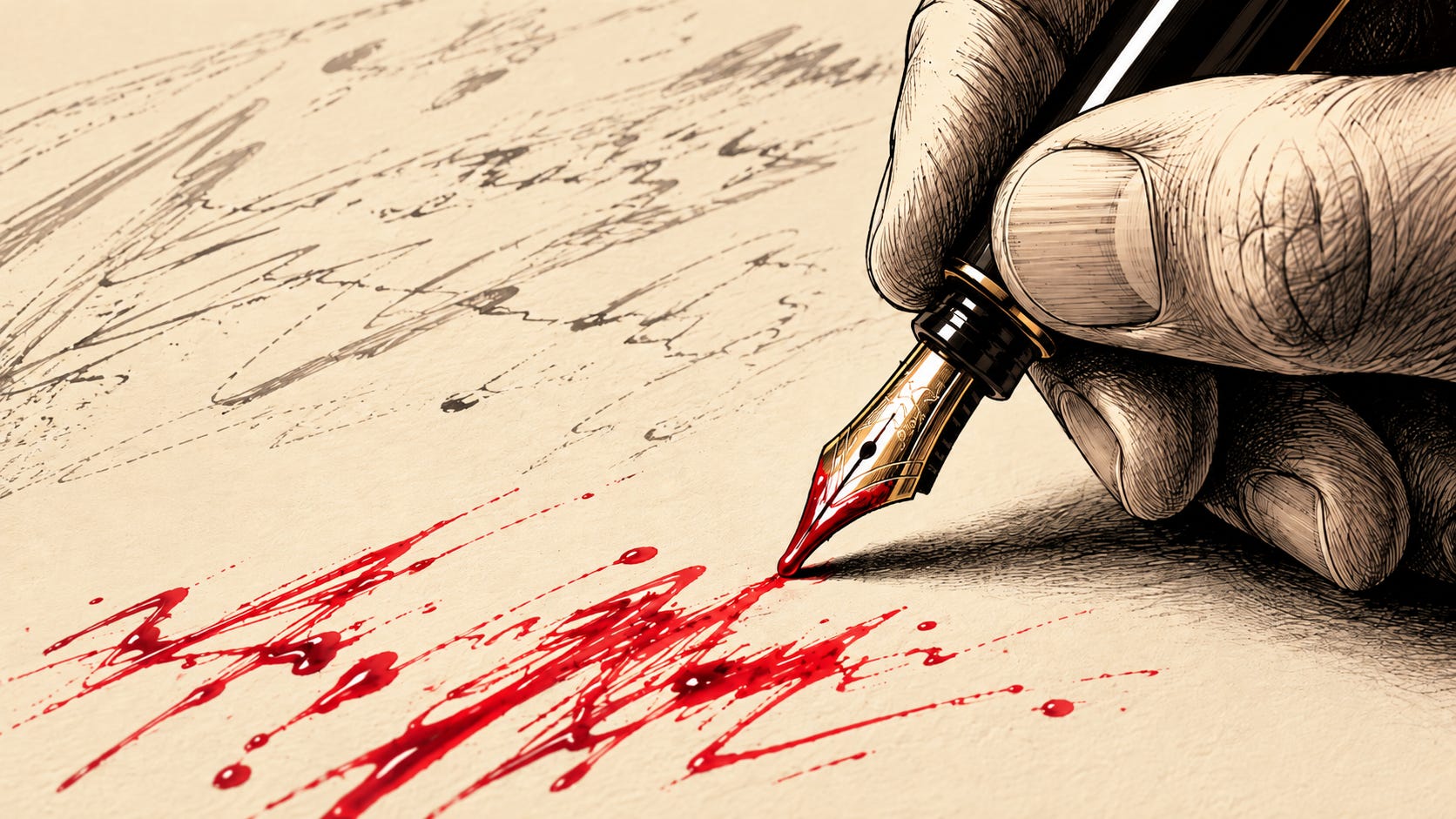
By hand. Word for word. The way you would if you were taking it to a secretarial service to have it typed.
That was it. The whole assignment. From one of the greatest copywriters alive to his own son.
Copy someone else’s work.
Was he hazing his son? Being lazy?
No. He was teaching him the same way every master who ever lived has learned.
Picasso spent years in the Prado, copying the old masters. He did not steal a thing until his hand could reproduce what his eye saw.
Bruce Lee absorbed wing chun, boxing, fencing, judo. Jeet Kune Do came later, after his body had copied enough movements to know which ones to keep.
Hemingway started as a journalist, copying the cadence of the reporters around him. His own voice arrived later, after something in him broke open from the inside.
Every one of them was a copycat first.
Your brain was built to do the same thing. It is how learning works.
When you see someone excel at something, you might feel a strong urge to try it. Your nervous system is seeking a template.
Three fields of science back this up. Neuroscience. Ecological dynamics. Ecological psychology. Each one shows what happens in your brain and body when you imitate someone skilled.
Your brain has one job. Minimize prediction error.
That is it. Every living organism with a nervous system has one main drive. This applies to both simple and complex beings. Predict what happens next. Check if you were right. Update. Repeat.
Living beings develop expectations about what they will encounter in the world. They put those expectations to use. They predict how information flows from engaging with that world. When the prediction matches reality, nothing happens. When it does not match, the brain updates.
That gap between prediction and reality is where learning lives.
Here is what is interesting. When you watch someone do something well, your brain does something strange. It simulates. It runs the same prediction loop as if your body were making the movement. Your neurons fire in patterns that mirror what you are seeing.
(You have felt this. Watching someone slip on ice makes your body flinch. Watching a boxer take a body shot makes your ribs tighten for a second. Or if you’re a guy reading this, when a guy gets hit in the nuts, you flinch right? That is your simulation engine running.)
When you copy someone skilled, you hand your brain a finished prediction model. Your brain borrows the template. It predicts. It checks. It updates. The gap closes faster because someone else already mapped the territory.
Scientists call this predictive processing. Imitation is the fastest way to load a working model into that engine.
Now consider the body.
For decades, the accepted model was simple. You practice a movement. Your brain encodes it. The movement sits there stored, ready for next time.
That model is broken.
Skill emerges from the relationship between you and your environment. Scientists who study this call it the performer-environment relationship. Change the performer, the environment, or the task, and the skill has to reorganize itself.
Bruce Lee found this out the hard way.
In 1964, traditional Chinese martial artists challenged him to a fight. They didn’t want him teaching their art to non-Chinese students. They sent a master named Wong Jack Man to face him. Bruce won. But he was distraught.
He felt he should have won faster. More efficiently. The classical Wing Chun he practiced since childhood had limits. He only saw them after that fight forced him to.
(Bruce was 24 years old. He had been studying the same martial art since he was 13. Eleven years of one system. And one bad fight was enough to make him start over.)
So he did what every master does. He started copying.
He studied boxing. Fencing. Judo. Every martial art he could find. He absorbed movements from each system. Then he let his body reorganize them.
His body was different from his teachers’ bodies. His opponents were different. The situations he faced were different. So the movements he copied adapted. They bent to fit his shape and his world.
Jeet Kune Do was the result. He reorganized everything he copied. It all focused on one body at a specific moment in history.
This is what ecological dynamics describes. Copying gives your body a set of constraints to work with. Your body, in your environment, adapts those constraints. What emerges is something new. Something that could not have come from you alone, and could not have come from the person you copied.
There is one more layer.
When you watch a skilled person, what are you actually picking up?
The movements are the surface. What lives underneath those movements is perception. The skilled player sees something the novice does not. An opening. A timing. A gap that is invisible to the untrained eye.
Ecological psychology calls these affordances. An affordance is a relationship between you and your environment. A ledge is a place to sit if you are tired. A ledge is a place to jump from if you are playing. The ledge has not changed. Your relationship to it has.
When you copy a master, you are borrowing their perception. You start to notice the same openings they notice. The same timing.
This is why imitation accelerates learning beyond what solo practice can do. You are loading a movement model and a perception model at the same time.
Austin Kleon nailed this in Steal Like an Artist. “Nothing comes from nowhere. All creative work builds on what came before. Nothing is completely original.”
He quotes T.S. Eliot: “Immature poets imitate. Mature poets steal. Bad poets ruin what they borrow. Good poets transform it into something better or at least something new.
Imitation loads the model. Your body adapts it and your perception sharpens. What comes out the other end belongs to you.
Picture this.
It is Monday morning. You sit at your desk, studio, stage, or court - wherever you’ve faced challenges.
You don’t need to create from scratch. Just look at work by someone who’s already mastered it. You pick one piece, one performance, one match, or one letter.
And you copy it.
Not for an hour. Not as a warm-up before the real work begins. This is the real work.
Your hands move like their hands moved. Your eyes trace the path their eyes traced. Your brain loads the model. Your body runs the simulation. The prediction engine fires, checks, and fires again.
By the end of the first week, something shifts. You feel it before you can name it. The movements come faster. The words flow smoother. The timing tightens. Your brain closes the gap between its predictions and reality faster than ever.
By the end of the first month, you notice something unexpected. You start to see what they see. The openings. The timing. The gaps you used to miss. Your perception sharpens because you borrowed theirs.
You didn’t study perception-action coupling or read about ecological psychology. Instead, you just copied someone who was skilled. Your nervous system did the rest.
By month three, your body begins doing something the master never did. The movements you copied bend and adapt to fit your shape, size, environment, and opponents.
You are not a clone. You are a reorganization.
By month six, something emerges from you that belongs to you. It could not have come from the person you copied because their body is not your body, and their world is not your world. It could not have come from you alone because you did not have the model.
This is the payoff.
You learn faster. You skip years of trial and error that come from trying to build something from nothing. You absorb a working system in weeks instead of inventing a broken one over years.
Your perception sharpens. You begin to see the game like the top players do. It is not just theory; you’ve borrowed their view long enough for your own to adapt.
And something original emerges. Not because you forced it. Your body, in your world, sets the limits. Those limits create something unique that only you can produce.
Now picture the alternative.
You keep trying to be original from day one. You stare at the blank page, the empty court, and the open canvas. You wish for something new to appear.
Six months pass. You still fumble. You remain stuck. You wonder if you lack talent.
The talent was never the problem. The approach was.
You tried to build a house without a blueprint. You tried to speak a language without hearing it spoken. You tried to run before you learned to walk the path someone else had already cleared.
Every master you admire spent years copying before they created. Picasso. Bruce Lee. Hemingway. Halbert. All of them. Copycats first. Innovators second.
Your brain is hardwired to do the same thing. The question is whether you will let it.
So here is what I want you to do.
Today. Not tomorrow. Not next week. Today.
Pick one skill you have been trying to learn. Just one.
Then pick one person who is already great at it. Someone whose work you admire. Someone whose output makes you think, “I wish I could do that.”
Now find one piece of their work. One letter. One essay. One performance. One match. One painting. One song. One.
And copy it.
Do not analyze it. Do not take notes on it. Do not write a summary of what you think they were trying to say.
Copy it. By hand if you can. Word for word if it is writing. Move for move if it is physical. Stroke for stroke if it is visual.
The medium does not matter. The act does.
Do it the way Gary Halbert told his son to copy the facelift ad. The way you would if you were going to take it to a secretarial service to have it typed.
That is your assignment. One piece. One copy. Today.
(If you are thinking, “I will start this weekend when I have more time,” you are already losing. You have enough time right now. Fifteen minutes is enough for the first one. The point is not the duration. The point is that your brain gets the template loaded.)
Do this every day for one week. Seven copies. Seven different pieces, or the same piece seven times if you want to go deep.
By day seven, you will feel something I cannot describe to you because I cannot describe it. You have to feel it. Your hands will know something your head does not yet know. That is the prediction engine updating. That is the model loading. That is your nervous system doing what it was built to do.
If you want to go deeper on the science behind this, three books are worth your time. Extended Consciousness and Predictive Processing by Kirchhoff and Kiverstein for the neuroscience. Steal Like an Artist by Austin Kleon for the philosophy. Here’s the paper “Being Water” by Myszka, Yearby, and Davids. It connects Bruce Lee to ecological dynamics.
But do not read them first. Copy first. Read second.
Halbert did not give his son a reading list. He gave him an assignment. Copy the facelift ad.
So copy something. Today. Right now.
Now. If you read this far, you probably felt something click. Something in you recognized that this is how learning actually works. And you might be thinking, “Okay, I get the principle. But how do I actually build a system around this? How do I take this from one copy exercise to a real practice that turns me into someone who is genuinely good at my craft?”
That is exactly what I built The Educated Eye for.
It is a 6-week cohort. Twenty spots. Starts October 12.
We take everything in this letter. The neuroscience of prediction error. The ecological dynamics of skill adaptation. The perception model from ecological psychology. The copywork method Halbert taught his son. All of it. And we turn it into a system you can use to become a masterful, one-of-one human in whatever craft you are working on.
Writing. Painting. Coding. Fighting. Playing. Building. Does not matter what the craft is. The mechanism is the same. Your brain loads the model. Your body adapts it. Your perception sharpens. Something original emerges.
The first 10 spots are $347. The last 10 are $497.
(Why the price jump? Because the first 10 people to commit are the ones who move fastest. They get the better deal. That is the only reason.)
Here is what I want you to do if you want in.
Go to the link below. Read the details. If it fits, grab one of the first 10 spots before they are gone.
Because they will be gone. Twenty spots is twenty spots. And the people who move on this are the same people who will move on the copy assignment above. They are the ones who do not wait for the weekend.
Do the copy assignment either way. Today. Right now. Whether you join the cohort or not.
If you want to move from copying to creating a real system that makes you a master, The Educated Eye is the place to do it.
Link is below. First 10 spots will not last.
And if you found this letter useful, share it with one person who is stuck trying to be original. They need this more than they know.
I will see you next time,
Sam